Monthly Archives: October 2009

New Mexico historical sports teams

Danny Schrader researches former New Mexico sports teams, such as the Albuquerque Six Guns, a professional hockey team that played one season in the ’70s. He is also a supporter of  the Animal Humane Association. I learned of his website  and operation in Sunday’s Albuquerque Journal Careers section.

He researches team histories and produces logo T-shirts for such old teams as:

  • Madrid Miners – AA Minor League: 1020s, ’30s and 40’s
  • Artesia Drillers – Longhorn League: 1951-1953
  • Carlsbad Potashers – Longhorn League, Southwestern League and Sophomore League: 1953-1956
  • New Mexico Storm – American Indoor Soccer League: 2004-2005

Regrettably, the only two sports teams I mentioned in the Albuquerque Timeline are Albuquerque’s first pro baseball team ‘The Albuquerque Dons’ in 1932, and the 1984 El Dorado High School Girls Basketball team that won 74 consecutive victories – the longest winning streak in the nation. It’s neat to learn that Danny is filling the blanks.

I think you will enjoy visiting Danny’s website at www.pdvintage.com and taking a look at his great logo T-shirts. Myself, I’m looking forward to seeing what other fascinating and interesting former New Mexico sports teams he finds.
New Mexico via Santa Fe RR circa 1911-1912

My sister in Colorado’s San Luis Valley recently brought me an old, old book with cover and publication pages missing. Based on historic event references, the book appears to have been written around 1911-1912 for the Santa Fe Railroad promoting passenger travel to the southwest. This fits interestingly with Ken Burns’ recent series on PBS on how the railroads used the National Parks to entice people to travel westward. Two early paragraphs stuck out for sharing in the context of this blog.

On page 20, the author riding the train has just come out of the half-mile Raton Pass tunnel from Colorado into New Mexico. “The landscape is oriental in aspect and flushed with color. Nowhere else can you find sky of deeper blue, sunlight more dazzling, shadows more intense, clouds more luminously white, or stars that throb with redder fire. Here the pure rarified air that is associated in the mind with the arduous mountain climbing is the only air known – dry, cool and gently stimulating. Through it, as through a crystal, the rich red of the soil, the rich green of vegetation, and the varied tints of the rocks gleam always freshly on the sight.”

And just a bit further along, on page 22, “You feel that this place has always worn much the same aspect that it wears today. Parcel of the arid region, it sleeps only for thirst. Slake that, and it becomes a garden of paradise as by a magic word. The present generation has proved it true in a hundred localities, where the proximity of rivers or mountain streams has made irrigation practicable.”

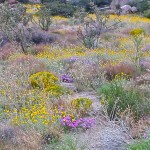
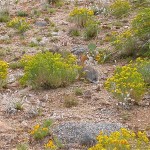
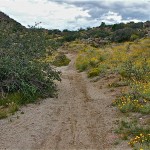
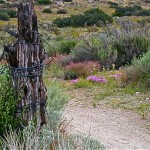
This is what the Sandia foothils looked like in August 2004 after some perfect thirst-slaking rain; for the previous 3 and past 5 years these same hills have been parcels of the arid region  —  can you pick out the rabbit in the last photo?

DSCN2173DSCN2190DSCN2168DSCN2201

New Mexico History – ‘El Gringo’ by W. W. H. Davis

I have just finished reading El Gringo, by W. W. H. Davis.  Davis’ 1853 description of New Mexico is one the earliest full-length accounts to appear in English. It provides a beautiful picture of a newly conquered land, its customs, languages, landscapes and histories.  He really captures the protected and unique nature of New Mexico in this paragraph:

“There is no country protected by our flag and subject to our laws so little known to the people of the United States as the territory of New Mexico. Its very position precludes an intimate intercourse with other sections of the Union, and serves to lock up a knowledge of the country within its own limits. The natural features differ widely from the rest of the Union; and the inhabitants, with the manners and customs of their Moorish and Castilian ancestors are both new and strange to our people. For these reasons, reliable information on this hitherto almost unknown region can not fail to be interesting to the public.”

Davis was a veteran of the Mexican War of 1846-48, and returned to New Mexico in 1853 to become United States Attorney for the territory. He traveled with only a few changes of clothes, a two-book law library and a ravenous curiosity, and he thoroughly journaled his entire travels to and throughout New Mexico.

His thousand-mile journey from Independence, Missouri to Santa Fe would take 25 days by mule train, traveling   in torrential rains and drifting blizzards. Many nights were spend sleeping on the ground under the wagons for shelter, and many meals were skipped due to inclement weather.

El Gringo was written by W. W. H. Davis (1820 – 1910) and first published in 1857. You can order from the Books page; enjoyi!